
Decoding neural signals to restore lives
Solving the last unsolved system
The nervous system is the body’s operating system.
Yet for decades, we lacked the tools to read its language.
At INBRAIN, we decode neural signals and translates them into intelligent autonomous therapy.
Built to decode, treat, and repair
Starting with brain disorders and extending to systemic diseases, our platform enables a future where therapies evolve in real time, personalized to every patient, every moment.
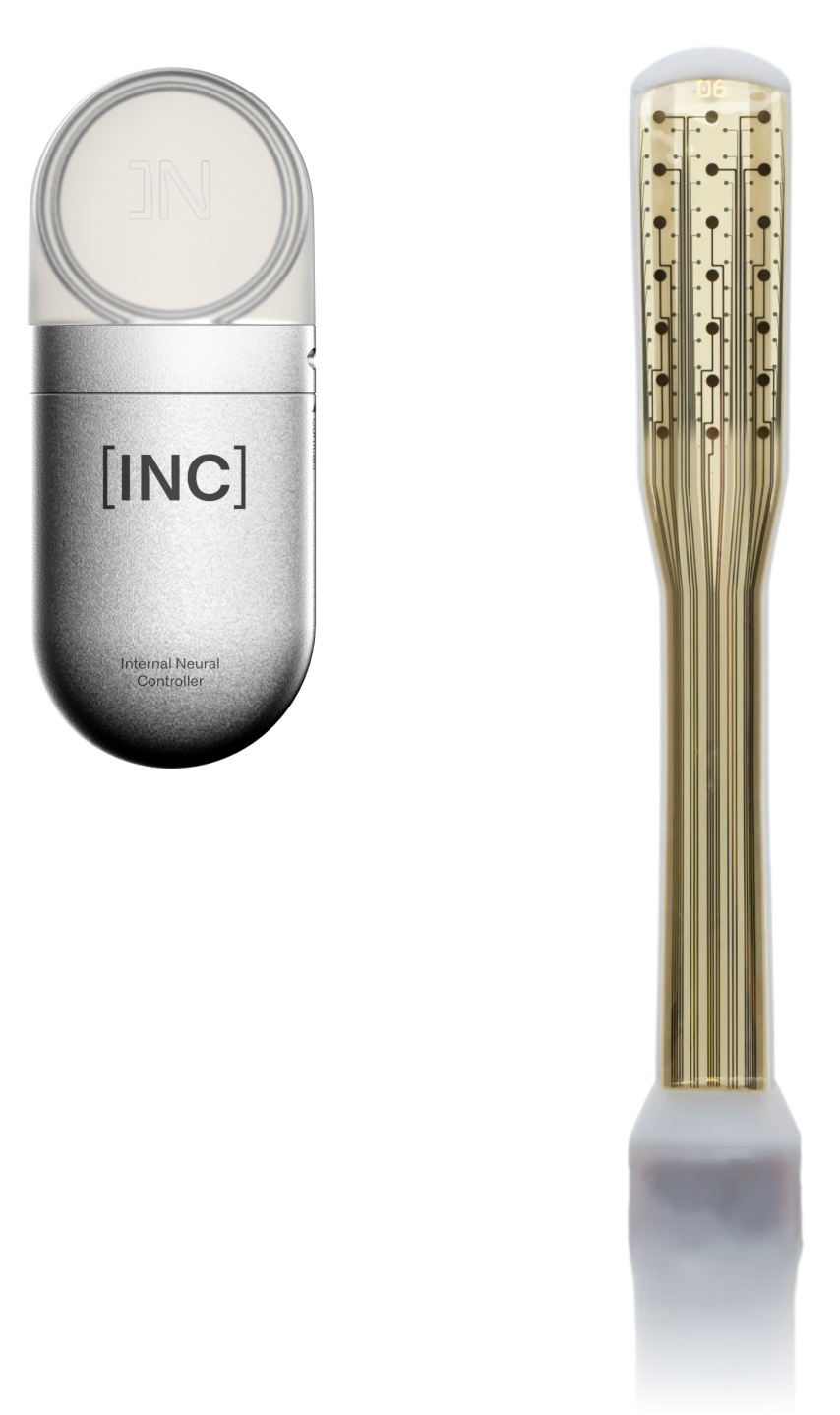
From signals to therapies
Our graphene interfaces read the nervous system at a resolution that wasn’t possible before.
Powered by AI, we turn those signals into real time personalized autonomous therapy.

Supported by partners who set the standard
INBRAIN collaborates with leaders in pharma, technology and clinical research to bring precision neurotherapy from lab to patient.
Each partnership validates a different layer of the platform: from bioelectronic medicine to agentic AI for autonomous care.





Latest achievements
-
PARTNERSHIP
2025, December
Strategic collaboration with Microsoft to deploy agentic AI for precision neurology -
CLINICAL
2025, July
Positive interim results confirm graphene BCI delivers neural fidelity beyond conventional materials -
CLINICAL
2024, September
World's first human procedure with a graphene-based brain-computer interface. -
REGULATORY
2024, January
Accepted into FDA Total Product Life Cycle Advisory Program (TAP). -
REGULATORY
2023, August
FDA grants Breakthrough Device Designation for Parkinson's disease therapy.
We are a team of Game Changers
We are a team of highly experienced frontier materials and neurotech believers, backed by leading tech and scientific advisors.
Latest news
-
Carolina Aguilar: Brain-Computer Interfaces that Heal Neural Circuits
May 20, 2026
Before founding INBRAIN, Aguilar spent 13 years at Medtronic, including a decade leading the company’s global neuromodulation business. … Her background in neuroscience research, including early work studying the relationship between pesticides and Parkinson’s disease, shaped a long-term interest in circuit modulation and neurotherapeutics.
-
Inside the BCI Race: How a Global Push to Bridge Minds and Machines Reveals Competing Paths Toward BCI Integration
May 20, 2026
The rapidly expanding brain-computer interface (BCI) field is not only driving cutting-edge neuroscience but also fueling a competitive race for market dominance. … Carolina Aguilar, CEO and founder of INBRAIN Neuroelectronics, told The Debrief in an email that her company prefers “to think in terms of implantable and non-implantable BCIs rather than simply ‘invasive’ and ‘non-invasive.’”
-
Carolina Aguilar, CEO i cofundadora d’INBRAIN Neuroelectronics: “Les persones són el premier en una entreprise, abans que qualsevol producte”
September 16, 2025
Després hi ha molts cofundadors de Neuralink que van sortir de l’empresa i van crear altres companyies molt competitives, com Precision Neuroscience o Science Corporation, però n’hi ha més. … INBRAIN es troba en una fase de creixement tant en infraestructures com en equip. Cap a on dirigiu la vostra evolució? L’any passat vam aconseguir una fita increïble en implantar per primera vegada una interfície de grafè al cervell humà.
-
InBrain, Microsoft team up on AI for neurology, BCI tech
November 10, 2025
Barcelona-based InBrain develops a graphene-neural BCI platform as an adjunctive therapy for treating Parkinson’s disease. In 2023, InBrain received FDA breakthrough device designation for the technology. It kicked off the first-in-human study last fall. … InBrain’s work sits at the intersection of neuroscience, bioelectronics, and AI, and we are proud to provide the data foundation and computational infrastructure that will help accelerate their mission to improve neurological health worldwide.”
-
Neurotech firm inks AI partnership with Microsoft
November 11, 2025
The collaboration aims to leverage Microsoft’s large language models and data analytics tools to enable adaptation of Inbrain’s interfaces in real time. … Inbrain Neurosciences recently partnered with Mayo Clinic to accelerate the clinical development and commercialization of its BCI therapeutics for neurological disorders, and the company is also engaged in ongoing clinical research led by the University of Manchester and the Manchester Centre for Clinical
-
Microsoft and INBRAIN Neuroelectronics Partner to Advance AI-Driven Brain-Computer Interface Therapeutics
November 12, 2025
“INBRAIN’s work sits at the intersection of neuroscience, bioelectronics, and AI, and we are proud to provide the computational infrastructure and data foundation that will accelerate their mission to improve neurological health worldwide.” … This allows the INBRAIN system to read and influence brain signals with incredible accuracy.
-
How we can develop brain-computer interfaces responsibly
January 18, 2026
Scientific and technological advances, including in neuroscience, are helping to unlock therapeutic solutions for illnesses originating from the brain and nervous system. … At INBRAIN Neuroelectronics, we believe that next-generation brain-computer interfaces must combine advanced neural materials with intelligent, adaptive systems.
-
At INBRAIN’s 5-Year Mark, BCI Experts Confront The Promise, Perils Of Brain-Computer Interfaces
February 2, 2026
At INBRAIN’s five-year anniversary event, Medtech Insight moderated a panel discussion with leading experts in neuroscience to talk about the future of BCI and neurotherapeutics.
-
INBRAIN Reports Positive Interim Results in its Graphene BCI Study
August 11, 2025
INBRAIN Neuroelectronics is sharing encouraging interim results from the world’s first-in-human clinical study of its graphene-based brain-computer interface (BCI) technology. … The study primarily aims to assess the safety of brain-computer interface (BCI) during brain tumor surgery. … “This convergence of advanced materials science, neuroscience, and AI is shaping the future of real-time, precision neurology.”
-
Inbrain completes enrolment of first-in-human study evaluating graphene-based BCI for brain decoding and mapping
April 29, 2026
BCI Inbrain Neuroelectronics has announced completion of patient recruitment in a first-in-human study evaluating its graphene-based brain-computer interface (BCI) technology. … “The ability to detect high-frequency neural activity with micrometre-scale precision and also modulate it provides a fundamentally new level of insight into brain-tumour interactions, and functional brain decoding and mapping,” said David Coope (Manchester Centre for Clinical Inbrain Neurosciences, Manchester
-
InBrain Neuroelectronics reports positive interim results from study of BCI tech
July 30, 2025
Barcelona-based InBrain Neuroelectronics shared interim findings from a first-in-human clinical study of its graphene-based brain-computer interface (BCI) technology. … InBrain’s implant is only 10 micrometers thick—thinner than a human hair—and is designed to safely decode and modulate neural signals with high accuracy.
-
First-in-human interim analysis finds no safety concerns with Inbrain’s graphene-based BCI technology
July 29, 2025
The study—sponsored by the University of Manchester and conducted at the Manchester Centre for Clinical Neurosciences in Manchester, UK—is evaluating the safety and functional performance of graphene-based electrodes when used during the surgical resection of brain tumours. … Regarding the potential clinical advantages of its BCI solution, Inbrain claims that graphene technology offers several benefits for neurosurgical procedures. … “This convergence of advanced materials science, neuroscience and AI [artificial intelligence] is shaping the future of real-time, precision neurology.”
-
An Ultrathin Graphene Brain Implant Was Just Tested in a Person
September 26, 2024
In 2004, Andre Geim and Konstantin Novoselov at the University of Manchester in England achieved a breakthrough when they isolated graphene for the first time. A flat form of carbon made up of a single layer of atoms, graphene is the thinnest known material—and one of the strongest. Hailed as a wonder material, it won Geim and Novoselov a Nobel Prize in 2010. Twenty years later, graphene is finally making its way into batteries, sensors, semiconductors, air conditioners, and even headphones.
-
Spanish Startup Inbrain Raises $50 Million for Brain Device
October 29, 2024
Company joins rivals like Elon Musk’s Neuralink in effort to treat neurological disorders with technology.
-
Spanish Startup Inbrain Raises $50M for Brain Device
October 29, 2024
Just how soon might we see such things as Parkinson’s and other diseases tackled? And how? Thank you. Thank you for having me here. And hello, New York.
-
InBrain Neuroelectronics reports positive interim results for BCI tech
July 29, 2025
InBrain Neuroelectronics today shared findings from a first-in-human study of its brain-computer interface (BCI) technology. The company’s technology integrates intelligent computing and graphene-based materials to decode and modulate real-time brain activity. … The study, sponsored by the University of Manchester and conducted at the Manchester Centre for Clinical Neurosciences (Northern Care Alliance NHS Foundation Trust), is evaluating the safety and functional performance of graphene-based electrodes when used during surgery for the resection of brain tumors … InBrain said the study has a primary objective of assessing the safety of InBrain’s BCI during brain tumor surgery. Secondary objectives include neural signal quality, brain stimulation delivery ability, performance consistency and overall sutability.
-
Why decoding the brain’s electrical language is the next frontier in precision medicine
June 5, 2025
At INBRAIN Neuroelectronics, we believe that decoding the brain’s electrical language will be as transformative for neuroscience as sequencing was for genomics.
-
Revolutionizing Brain-Computer Interfaces via Groundbreaking Graphene Technology
January 23, 2024
We are thrilled to share that the GphT-BCI project, led by INBRAIN Neuroelectronics in collaboration with Institut Català de Nanociència i Nanotecnologia (ICN2), is set to revolutionize brain-computer interface (BCIs) through groundbreaking graphene technology.
-

Elon Musk’s Neuralink is being outperformed by this Spanish graphene startup
August 11, 2023
Inbrain’s neural implants will be used to treat conditions like Parkinson’s and epilepsy.
-

Inbrain Neuroelectronics and Merck KGaA collaborate to develop the next generation of bioelectronic
July 8, 2023
Joint development agreement represents a promising step towards a highly selective and efficient next generation of bioelectronic therapies powered by graphene
-
11 medical device startups to watch, according to investors
July 1, 2023
Inbrain develops tiny neuro-electronics — miniature interfaces that connect the nervous system with electronic devices — as next-generation neural disease solutions, which represents huge market potential with advanced material science